When Judgment Meets Data
Why Emotion Still Decides

It’s tempting to believe that better data will guarantee better decisions. But human judgment has never been purely rational, it’s an emotional negotiation between instinct and intellect.
Data sharpens our thinking. Emotion gives it gravity. It determines what we care about, what we ignore, and what we act on.
Sometimes we forget this; we don’t reason to feel; we feel to reason. That isn’t sentimentality - it’s neuroscience. Research (Search: Antonio Damasio) shows that without emotion, our brain cannot prioritize or choose. When emotion is removed, analysis continues indefinitely, maybe even factually correct, but judgment stalls, and the best decision may not be the one made.
And so, paradoxically, the more data we have, the more emotion we need, not less, to interpret it wisely.
The Emotional Architecture of Decision-Making
Every decision, personal and at work, passes through three emotional filters:
Fear - What might we lose?
Hope - What might we gain?
Meaning - Why does it matter?
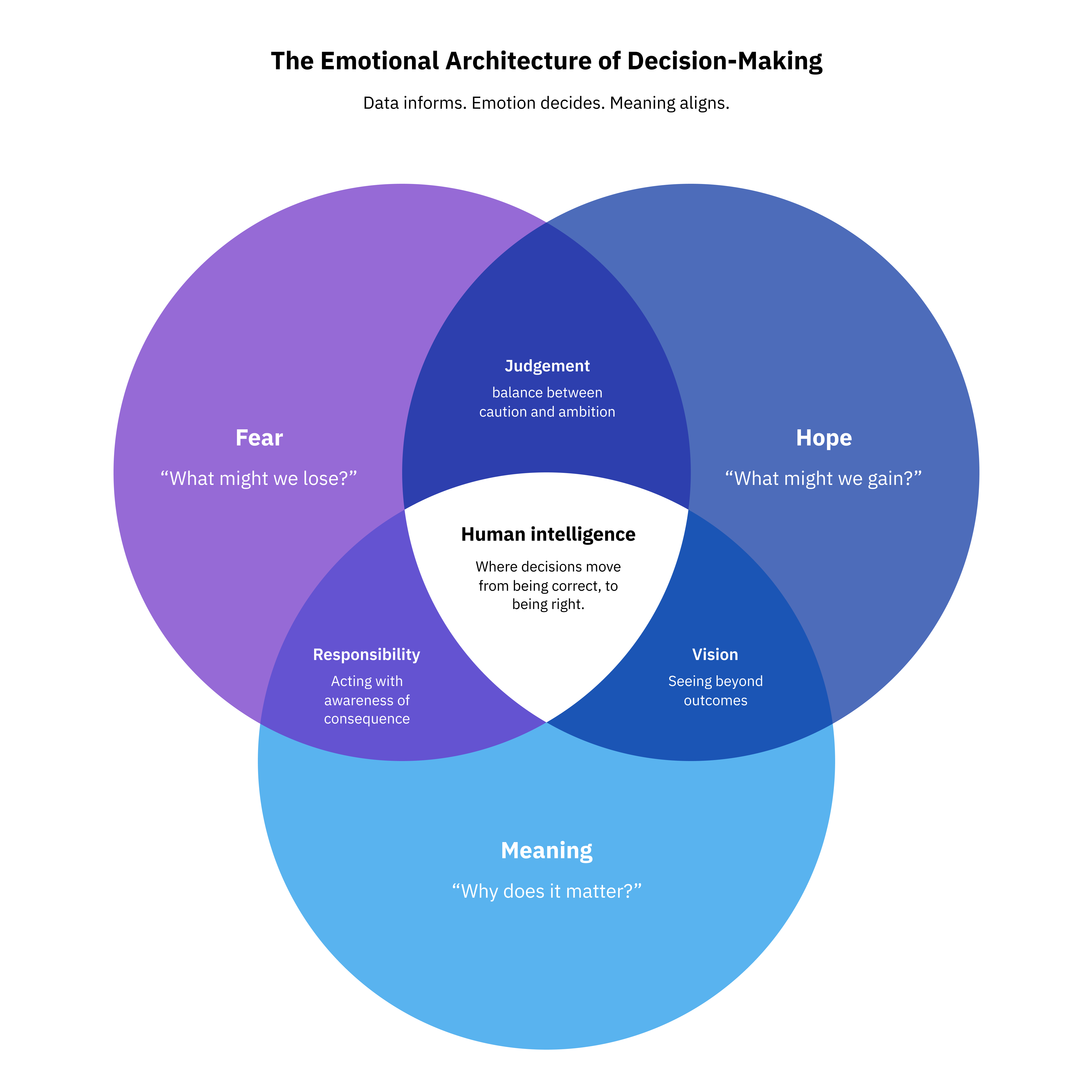
Analytics speaks fluently to the first two. Entire industries are built around quantifying risk and modeling opportunity. But we struggle with the third, meaning.
Meaning is the moral dimension of intelligence: the ability to connect outcomes to purpose. It’s what turns a metric into a movement, a dashboard into a decision that changes lives.
When we ignore meaning, our decisions become transactional, precise, efficient, and soulless. When we incorporate it, our decisions become transformational, informed by insight but guided by empathy. To analysts this may sound appealing, but without meaning we easily fall in the trap of optimizing for the wrong thing. Revenue might increase if you offer 50% off your products, a completely reasonably decision to make if the goal is to improve sales. Clearly an oversimplified scenario, but the truth holds in complex ones.
Humanity Within Intelligence
I believe business/data/analytics intelligence should serve, not replace, us. Data and AI can illuminate patterns, surface probabilities, and accelerate outcomes, but only people can decide what should be done with them.
That’s the next frontier for analytics: not just faster decisions, but wiser ones. Ones that integrate the science of data with the psychology of judgment.
Because the future of analytics isn’t about removing emotion - it’s about understanding it, designing for it, and leading through it.
When we do that, our dashboards become more than instruments of measurement. They become mirrors of intention - reflecting not just how well we perform, but how deeply we care about the impact of those decisions on the people and objectives they serve.